October 22, 2025
Best Grant Opportunities for Police Departments 2025
Police departments in 2025 face increasing demands with limited budgets. Federal and state grants offer funding for hiring, technology upgrades, training, and community-focused programs. However, the application process requires careful preparation, compliance with regulations, and detailed reporting.
Key 2025 Grant Opportunities:
- COPS Hiring Program: Supports hiring officers for community policing.
- BJA Grants: Funds body cameras, forensic labs, and tech improvements.
- Specialized Grants: Focus on de-escalation training, rural policing, and cybersecurity.
Success Tips:
- Prepare early; applications often open in spring or summer.
- Ensure compliance with systems like SAM and Grants.gov.
- Use tools like Grantwell for grant discovery, application management, and compliance tracking.
Federal funding can significantly improve operations, but departments must focus on clear goals, compliance, and effective tools to secure and manage grants.
The Federal Funding Process: The First Steps to Applying, How to Prepare Now, & Other Considerations
Federal Grant Programs for Police Departments
Federal agencies are offering a wide range of funding opportunities for police departments in 2025, aimed at tackling staffing shortages, upgrading technology, and addressing operational needs. While these grants provide crucial financial support, each comes with specific requirements and deadlines that departments must carefully manage.
Most applications open in early spring, so it's wise to start preparing documents ahead of time. These programs are designed to meet the varied needs of law enforcement agencies across the country.
Community Oriented Policing Services (COPS) Hiring Program
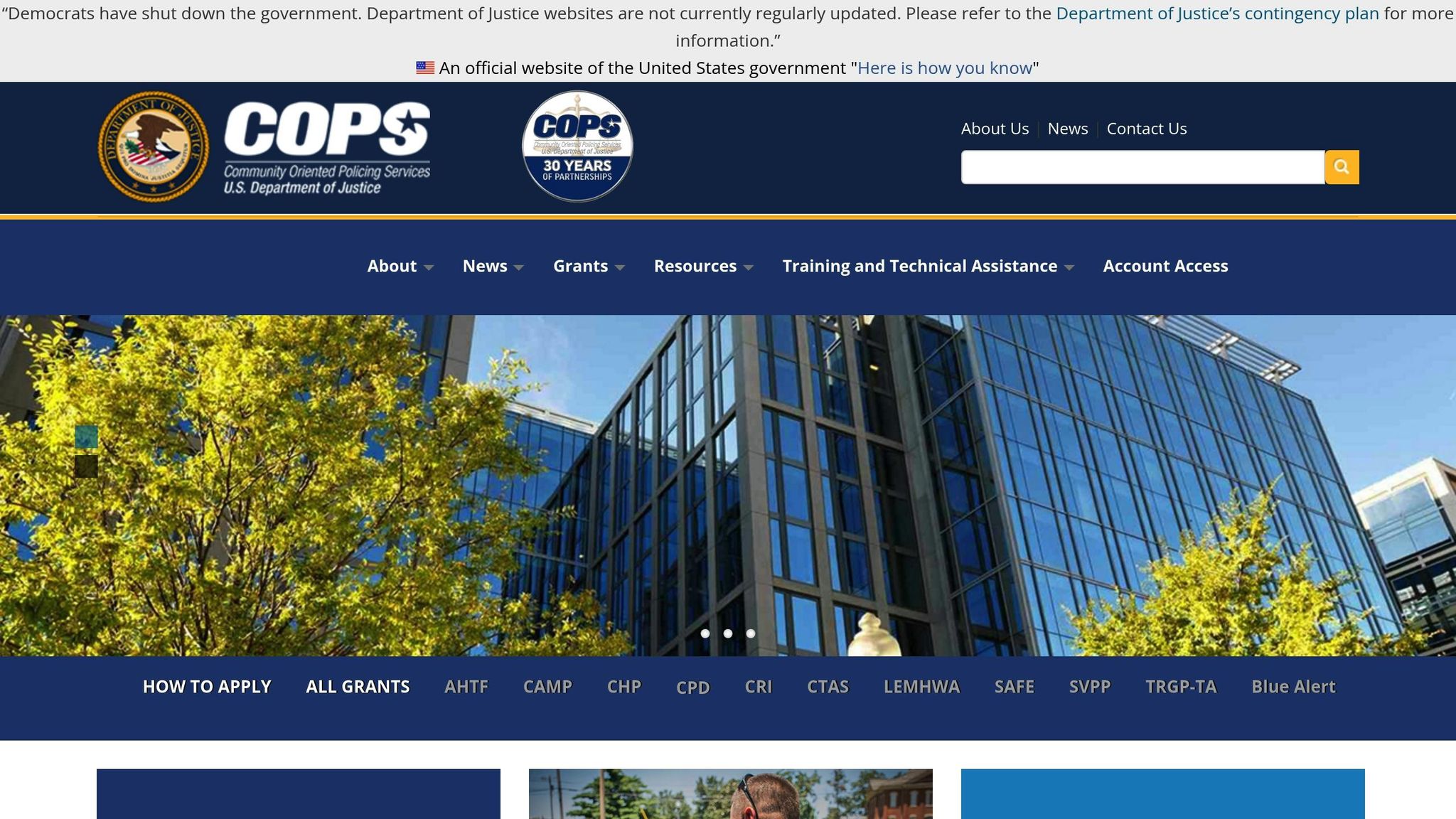
The COPS Hiring Program focuses on helping departments hire and retain sworn officers. In 2025, this program provides substantial funding per officer position over several years, with the federal government covering the majority of approved costs.
This funding is specifically aimed at departments committed to community policing practices. Eligible expenses include officer salaries, fringe benefits, and hiring-related costs. Departments can meet the required local funding match through cash contributions or in-kind support, such as access to training facilities or essential equipment.
To qualify, departments must agree to maintain the funded positions beyond the grant period using local resources. They are also required to actively engage in community policing and submit regular progress reports detailing officer deployment and community engagement efforts.
Key Dates: Applications open in mid-June, with awards announced later in the summer. Priority is often given to departments in smaller communities or those facing budget and staffing challenges. This program is a direct way to bolster public safety by strengthening community policing efforts.
Bureau of Justice Assistance (BJA) Grants
The Bureau of Justice Assistance (BJA) offers a variety of grants designed to modernize law enforcement operations. These programs address critical needs like technology upgrades and specialized training. For 2025, some of the standout BJA programs focus on body-worn cameras, forensic laboratory improvements, and data-driven policing strategies.
- Body-Worn Camera Policy and Implementation Program: This grant covers the purchase of cameras, the development of privacy and data storage policies, and personnel training. Applications are typically open in the spring.
- Forensic Science Improvement Grants: These grants aim to improve forensic labs by funding equipment upgrades, training, and capacity building. Departments dealing with evidence backlogs or looking to adopt new forensic technologies can benefit from this funding.
- Technology Innovation for Public Safety Program: This program supports departments adopting advanced technologies like artificial intelligence, predictive analytics, or enhanced communication systems. Applicants are required to submit detailed privacy impact assessments and demonstrate strong community engagement as part of the application process.
These grants are designed to enhance public safety through improved investigative and operational capabilities, making them a valuable resource for departments looking to modernize.
Specialized Federal Grant Programs
In addition to the major COPS and BJA programs, there are several specialized grants that address specific challenges in law enforcement. These programs often have higher success rates for departments that can present well-prepared applications.
- De-escalation Training and Mental Health Response Grants: Administered by the Department of Health and Human Services, these grants support crisis intervention training and partnerships with mental health providers. The goal is to reduce use-of-force incidents through better training and response protocols.
- Violence Intervention and Prevention Grants: These grants fund community-based strategies to reduce gun violence and gang activity. They often involve partnerships with local organizations, schools, or social service agencies and emphasize data-driven approaches with measurable outcomes. Applications are generally due in the summer.
- Rural Law Enforcement Enhancement Program: This program is tailored for departments in smaller communities, offering funding for equipment, training, and technology upgrades. It focuses on addressing the unique challenges of rural policing, such as large patrol areas and limited backup resources.
- Cybersecurity and Digital Evidence Grants: As digital investigations become more common, these grants provide funding for cybersecurity improvements, digital forensics training, and equipment to combat online crimes. Applicants must submit detailed cybersecurity assessments and plans to protect sensitive law enforcement data.
Each program has its own set of guidelines, eligibility criteria, and documentation requirements. Success often hinges on demonstrating clear community needs, building strong partnerships, and showing measurable outcomes that improve public safety. Careful preparation and attention to detail can make all the difference in securing these critical funds.
Grant Application Preparation and Compliance
Crafting a successful grant application requires attention to detail and strict adherence to federal regulations. Breaking the process into manageable steps can help reduce errors and improve the chances of securing funding.
Eligibility and Documentation Requirements
Before applying, departments must confirm their eligibility by ensuring their registration in SAM (System for Award Management) is active. This registration requires annual renewal and submission of a notarized letter designating an authorized Entity Administrator [2]. Once registered with SAM, applicants must also register with Grants.gov to complete the Standard Form 424 (SF-424) [2].
For 2025, programs like the COPS Hiring Program and Community Policing Development required applications to be submitted through both Grants.gov and the JustGrants system [1].
Each grant program provides detailed guidance to help applicants meet specific requirements. For instance, the FY25 COPS Hiring Program offers an Application Resource Guide outlining eligibility criteria and necessary supporting documents [1]. Similarly, the FY25 Community Policing Development program provides a Resource Guide for Community Policing Advancement Programs [4].
Key components of an application include a well-structured project narrative and a thorough budget. The narrative should clearly articulate the department's objectives and avoid overuse of jargon, while the budget must align with the narrative and address any foreseeable questions [3].
Compliance with federal certifications is equally important. For example, departments must adhere to 8 U.S.C. § 1373, which prohibits restrictions on the exchange of information about citizenship or immigration status between federal, state, or local entities [1].
Starting the preparation process early is essential. This includes keeping all registrations and user accounts up to date [5]. For assistance, applicants can reach out to Grants.gov customer service, JustGrants Support, or the COPS Office Response Center [1].
Once all documentation is complete, maintaining compliance and audit readiness is critical to sustaining grant eligibility.
Compliance and Audit Readiness
Effective compliance practices are vital for protecting current funding and ensuring smoother applications in the future. To maintain compliance throughout the grant period, departments must implement robust financial management systems and adhere to strict reporting standards. Establishing strong internal protocols can help avoid audit issues and preserve eligibility for future funding opportunities [6].
A reliable tracking system should be used to categorize all grant-related expenses - such as personnel, travel, and equipment - ensuring they align with the approved budget [6]. Regular internal audits can help identify and address potential issues before external reviews occur [6].
In addition to financial oversight, departments should monitor project performance by tracking outcomes and demonstrating the impact of their initiatives. Maintaining detailed records of activities, expenses, and results is crucial for preparing required reports and responding to audits [6].
Sustainability planning should begin during the application process and continue throughout the grant period. Departments must develop strategies to sustain grant-funded programs after federal funding ends [6]. Open communication about progress, challenges, and lessons learned fosters trust with federal agencies and community stakeholders, paving the way for future funding opportunities [6].
To assist with compliance, the Department of Justice provides resources like the Grant Application Submission Checklist and the JustGrants Resources website. These tools include eLearning videos, reference guides, and detailed checklists to help applicants navigate complex requirements [5].
sbb-itb-6e14cfc
How Grantwell Supports Police Departments
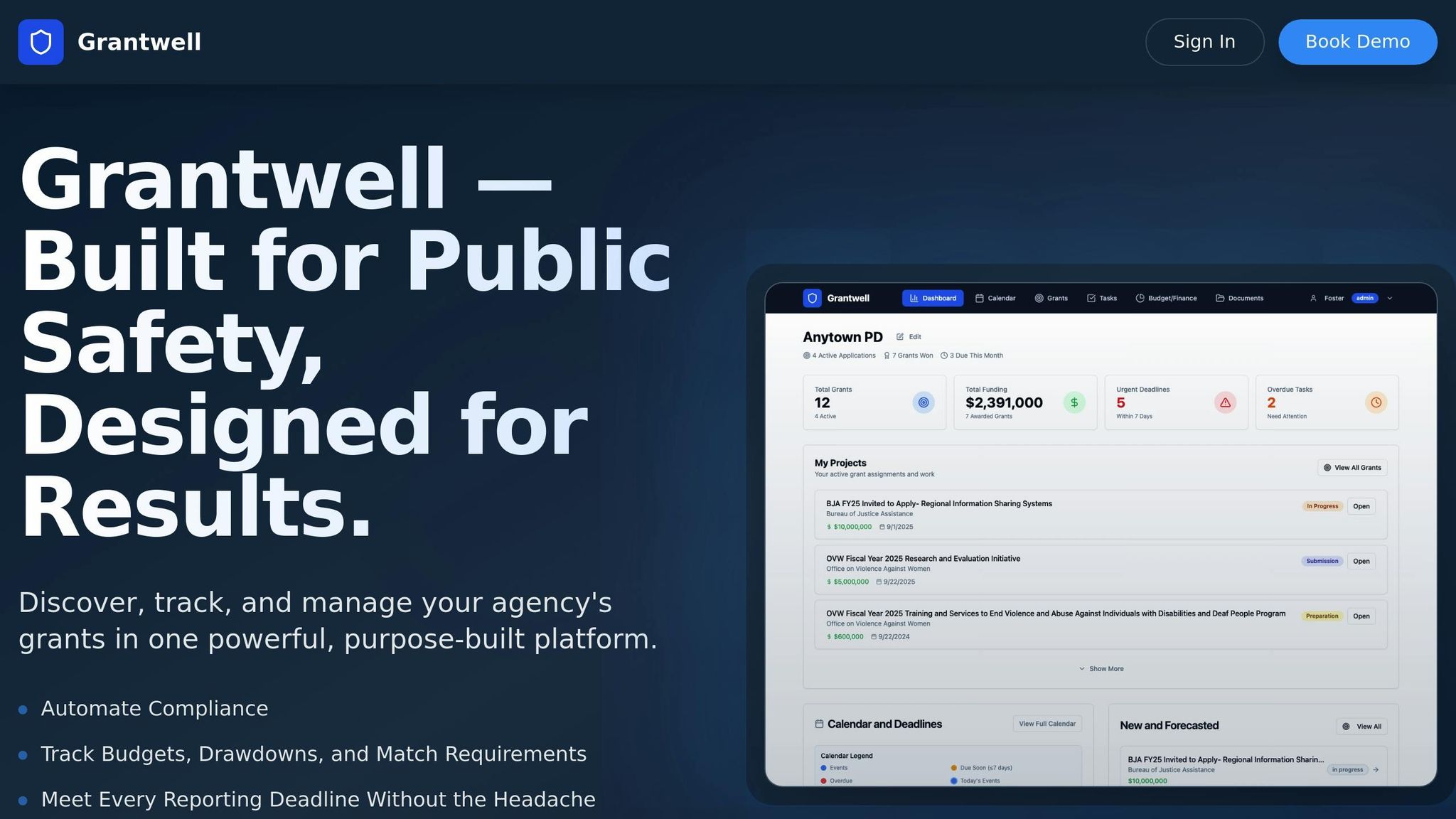
Grantwell offers a platform tailored to meet the specific needs of police departments, ensuring compliance with CJIS and FedRAMP standards. Unlike general-purpose systems, it simplifies the grant process while addressing the security and regulatory requirements unique to law enforcement agencies.
With Grantwell, departments can manage everything from grant discovery to post-award reporting within a single, secure system. By automating tedious tasks and maintaining adherence to federal guidelines, the platform streamlines operations throughout the grant lifecycle.
Grant Discovery and Application Management
Navigating the maze of federal and state grant opportunities can be daunting. Grantwell's Admin Dashboard and NOFO Scraper take the hassle out of this process by automatically fetching new Notices of Funding Opportunities (NOFOs) from Grants.gov every day. These NOFOs are stored, indexed, and made searchable, saving staff from manually monitoring multiple funding sources and reducing the risk of missing critical deadlines [7].
The platform also includes a NOFO Summarization feature, which breaks down complex grant documents into manageable pieces. Key details like eligibility requirements, necessary documentation, narrative components, and deadlines are extracted and categorized for easy review. During a pilot program in Massachusetts, this feature proved its effectiveness by processing multiple NOFOs efficiently [7].
To assist grant writers, the AI Chat Assistant provides quick answers to eligibility questions, helps navigate specific NOFO sections, and even offers writing support. This tool makes it easier for departments to assess their eligibility for programs like the COPS Hiring Program or BJA grants without wading through dense federal documents [7].
When it comes to building applications, the Guided Grant Writer offers a step-by-step workflow. Users are guided through project basics and custom questionnaires, while AI drafting tools generate narrative content section by section. This ensures applications are complete, aligned with funder expectations, and free of common errors. Departments can also use features like automated grant timelines and a real-time grant finder to plan their strategies and identify multiple funding opportunities that match their goals.
Compliance and Post-Award Reporting
Grantwell doesn't stop at application development - it also simplifies the complex post-award process. With tools designed specifically for police departments, the platform ensures ongoing compliance with federal requirements.
The budget builder and amendments feature allows departments to create detailed budgets that meet federal standards and adjust them as project needs change. A budget vs. actual tracker provides real-time insights into spending, helping to prevent category overspending that could lead to audit issues.
To manage grant-related expenses, the platform includes an expense pipeline feature tailored to law enforcement needs. It tracks costs across personnel, equipment, training, and other approved categories, ensuring all expenditures align with the original grant proposal and federal guidelines.
For reporting, Grantwell automates document preparation, including performance reports and Federal Financial Reports (FFR SF-425). Its JustGrants-compatible interface makes submitting reports to federal systems straightforward, easing the administrative burden on staff. Smart alerts also notify users of upcoming deadlines, reducing the risk of delays that could jeopardize funding.
Additional features like real-time financial summaries, clean CSV exports for audits, and drawdown efficiency scoring help departments optimize their use of federal funds. The match contribution tracker simplifies documenting local funding commitments, a crucial requirement for grants involving cost-sharing.
While Grantwell already offers robust tools for application and compliance management, its roadmap includes advanced audit readiness features to further support police departments in the future [7].
Grant Funding Strategies for 2025
Police departments are up against stiff competition when it comes to securing federal funding. To stand out, they need a well-thought-out strategy that treats grant funding as an ongoing effort rather than a one-time task. The most successful departments align their approach with federal priorities, focusing on clear, results-driven applications.
Start planning early - long before deadlines hit. This gives you time to assess your department's needs, engage with stakeholders, and gather data that highlights measurable outcomes. Funders are drawn to proposals that clearly connect requested funds to tangible improvements in community safety.
Grant Planning and Tracking
To stay ahead, departments should approach grant activities in an organized, systematic way. A great first step is creating a grant calendar that maps out deadlines and sets internal milestones to keep everything on track.
Collaboration across various units - patrol, investigations, community relations, and administration - can bring fresh perspectives to the table, making applications stronger. Using a tracking system to log application details, feedback, and budgets can also be a game-changer. Over time, this historical data helps refine future proposals.
Managing timelines effectively is another key piece of the puzzle. Set internal deadlines well in advance of submission dates to allow for final reviews and troubleshooting. Keep a running list of departmental priorities by tracking equipment needs, training gaps, and community concerns throughout the year. This ensures that your proposals reflect real priorities instead of chasing funding trends. Regularly touching base with federal program officers can also provide valuable insights into shifting funding priorities and application preferences.
Using Data to Strengthen Applications
Data is your best ally when it comes to crafting a compelling grant application. Go beyond basic crime stats to showcase the department's operational success and its impact on the community. Funders want to see detailed data that paints a clear picture of specific challenges and trends, making your case for funding hard to ignore.
Accurate financial documentation is equally important. Make sure your budget requests are backed by up-to-date pricing and align with the outcomes you're promising.
Community engagement data can add another layer of appeal. Include things like survey results, attendance at community meetings, or partnership agreements to show that your department is deeply connected to the community it serves. Establishing baseline metrics - whether it’s response times, case clearance rates, or community satisfaction - allows you to present convincing before-and-after comparisons in progress reports.
Technology can also play a big role in strengthening your case. Highlight how tools and systems can improve data sharing, streamline operations, or enhance officer safety. A cost-effectiveness analysis can go a long way too - showing, for example, how a training program could reduce incidents or cut liability costs makes for a strong financial argument. Partnering with other agencies and sharing collaborative data further boosts credibility by showing broad support and the potential for lasting partnerships. Tools like Grantwell’s data integration can help refine these metrics, giving your application an extra edge.
Conclusion: Grant Success for Police Departments
Securing federal grant funding in 2025 demands a thoughtful approach that blends detailed planning, a strong grasp of compliance requirements, and the use of effective technology tools. For police departments, grant funding isn't a one-and-done task - it's an ongoing effort that requires consistent attention.
Federal programs like the COPS Hiring Program and BJA grants play a central role in successful applications. The key is aligning your department's goals with the priorities of these funding programs to craft applications that are both relevant and competitive.
Compliance is the backbone of maintaining long-term funding opportunities. Departments that prioritize proper documentation, audit readiness, and thorough post-award reporting not only protect their current funding but also position themselves for future success. Avoiding compliance missteps is essential to keeping these opportunities open.
Technology is another critical piece of the puzzle. Platforms like Grantwell help police departments streamline the grant process, offering tools for automated compliance tracking, real-time grant discovery, and reporting compatible with JustGrants. These features allow departments to focus on their mission while meeting grant requirements. Additionally, Grantwell’s CJIS and FedRAMP alignment ensures the platform meets the rigorous security standards required by law enforcement.
The most successful departments also rely on a data-driven approach to grant funding. By analyzing application outcomes, tracking community impact, and using past performance to improve future proposals, agencies can stay competitive in a crowded funding landscape. This focus on data strengthens the entire grant management process, from planning to execution.
Looking ahead to 2025, police departments have a chance to create lasting advantages by adopting systematic grant management strategies. Prioritizing strategic planning, strict compliance, and advanced technology now will pave the way for securing funding well into the future.
FAQs
What steps should police departments follow to submit a strong grant application in 2025?
To put together a strong grant application in 2025, police departments need to take a few key steps to stay ahead of deadlines and requirements. First, make sure your organization is registered and active in SAM.gov with a valid Unique Entity Identifier (UEI). It's a good idea to start this process at least 30 days before the submission deadline to avoid any last-minute issues.
Once that's done, submit your initial application through Grants.gov early - ideally 48 hours before the deadline. This gives you a buffer to address any errors or technical issues that might pop up.
Be sure to thoroughly review the funding opportunity's guidelines to confirm your project aligns with its objectives and that your department meets all eligibility criteria. Gather essential documents, like financial statements, ahead of time, and plan to complete the full application in JustGrants by the specified deadline. A well-organized, proactive approach can make your application stand out in a competitive field.
What steps can police departments take to stay compliant with federal regulations when managing grants?
To ensure compliance with federal regulations throughout the grant process, police departments need to carefully review the guidelines set forth by the U.S. Department of Justice's Office of Justice Programs (OJP). These resources provide detailed instructions for responsibly applying for, managing, and reporting on grant funds.
Departments are also required to follow stricter oversight measures, including routine audits and reviews of discretionary awards, as highlighted in recent federal policies. Keeping detailed records, staying organized, and performing internal compliance checks are essential steps to ensure funds are used properly and align with federal expectations.
What are the benefits of using Grantwell to manage police department grants and compliance?
Grantwell offers police departments a straightforward way to handle grant applications while staying on top of compliance requirements. Built specifically for law enforcement and municipal agencies, it takes the complexity out of the grant process, allowing departments to focus on securing funding for essential priorities like new equipment, officer training, and community programs.
The platform is CJIS- and FedRAMP-aligned, ensuring sensitive data is managed securely and meets both federal and state compliance standards. By automating tedious tasks - like tracking deadlines and organizing documentation - Grantwell not only saves time but also minimizes errors. This efficiency helps police departments make the most of their funding opportunities, supporting their mission to improve public safety.